Saving Faith: Its Object and Function
Editor's Note: This article is an adapted excerpt from the book Soteriology 101-Jesus Christ: Our Complete Savior and Lord by Chris Brown.
Chris Brown - January 31, 2026
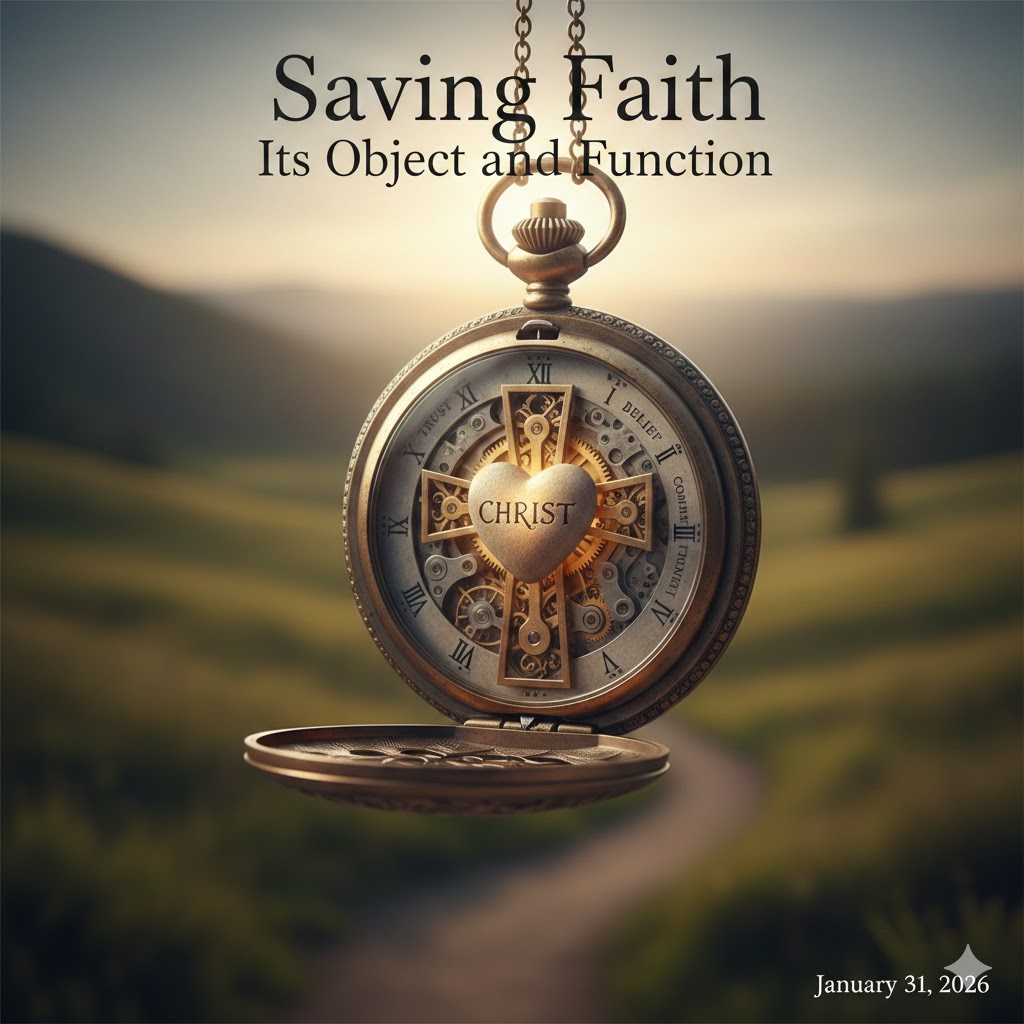


"The salvation lies not in the faith, but in the Christ in whom faith trusts." —Charles H. Spurgeon, All of Grace
What Must a Sinner Believe?
The gospel does not call sinners to believe in the doctrine of justification by faith in order to be justified. This represents a fundamental confusion about the nature of saving faith. Sinners do not come to God thinking, "I want to be justified; therefore, I will believe." Rather, when sinners put their faith in Christ, they are justified as the result of that faith.
Consider Abraham's example in Romans 4. Abraham did not believe God in order to be justified. Scripture teaches that because Abraham believed God, he was justified. The distinction is crucial: justification follows faith; it is not the conscious goal of faith.
This distinction matters because justification is not the gospel offer itself but rather one aspect of God's comprehensive salvation. When a person is converted through repenting and believing on the Lord Jesus Christ, that person receives the legal, instantaneous imputation of Christ's righteousness (Romans 3:24-26; 4:25; 5:9). Yet significantly, the apostles did not preach justification as an abstract doctrine for people to seek. They preached Christ Himself. People came to Christ, and in that coming, they exercised the faith that justified them.
Modern evangelicalism has often reduced salvation to merely getting sins forgiven for entrance into heaven. But salvation encompasses far more than forgiveness, and the faith that brings sinners to Christ is the same faith that justifies them. The sinner sees Christ's loveliness, perfection, and goodness and is drawn to Him. This drawing to Christ is faith, and this faith results in justification.
An unbeliever stands unconvinced that Jesus is Lord and Savior. When that unbeliever becomes truly convinced that Jesus is Lord and Savior and flees to Him for mercy, that person is justified. But this justification is not the result of someone seeking to be justified by faith; it is the result of coming to God in faith.
The crucial point is this: The sinner is not asked to believe, "If I trust Christ, then God will declare me righteous." That would make justification the object of faith and transform faith into a meritorious work, as though the sinner were saying, "I believed the right formula, now give me justification."
Rather, the sinner is confronted with Christ Himself in all His glory: His person, His deity, His death, His resurrection, His present authority and loveliness. The sinner is drawn to flee to Him, to bow before Him, to cry out for mercy from Him, to find refuge in Him. That movement toward Christ is faith, with repentance being the other side of the same coin.
The moment a sinner believes in Christ, trusting Him, receiving Him, calling upon Him, God instantly and irrevocably justifies that sinner. This occurs not because the sinner understood the doctrine of justification, but because the sinner has embraced Christ who is our righteousness.
Justification is therefore a judicial declaration that accompanies true faith, not the prize for which the sinner consciously bargains. The tax collector in the temple did not ascend thinking, "I will exercise faith in order to secure imputed righteousness." He went up thinking only, "God, be merciful to me, a sinner!" Yet Jesus declares, "This man went down to his house justified" (Luke 18:13-14). Mercy was what he sought; justification was the gift he received because the mercy he sought was found in the Person who justifies.
Romans 4 addresses believers, not unbelievers. Paul does not present Abraham as a model for how the unconverted can achieve justification. Rather, he shows already converted Jews and Gentiles that God never declared them righteous based on law keeping but always on the same principle by which He justified Abraham: faith in God, specifically faith in the God who raised Jesus from the dead.
Therefore, the gospel offer is not, "Believe that justification by faith is true and you will be justified." The gospel offer is, "Jesus is Lord. He died for sinners and rose again. Flee to Him. Bow to Him. Trust Him. Call on His name."
Everyone who does so is justified the moment they do it, whether they can define imputation or not.
This is why the New Testament can proclaim both "Believe on the Lord Jesus Christ, and you will be saved" (Acts 16:31) and "a man is justified by faith apart from the deeds of the law" (Romans 3:28) without any contradiction. The first is the invitation; the second is the divine explanation of what happens when someone accepts that invitation.
This distinction rescues justification from becoming another work that the sinner must perform correctly to gain acceptance. Instead, justification is the astonishing verdict pronounced over everyone who has been brought to cling to Christ in all His saving glory.
The Instrument, Not the Cause
Having established that the object of faith is Christ Himself rather than the doctrine of justification, a further clarification is necessary. What exactly does faith do? How does faith relate to the salvation it receives? The distinction between instrument and cause is crucial for understanding justification.
Consider an analogy: when a dying man receives an antidote through a syringe, we do not say that the syringe saved him. The syringe was merely the instrument; the antidote was the saving agent. If the man were to boast, "I was saved by my syringe!" we would correct him: "No, you were saved by the antidote. The syringe was simply the means by which you received it."
So it is with faith and Christ. Faith is the syringe; Christ is the antidote. Believers are not saved because of their faith, as though faith were a virtue that merits God's approval. They are saved through faith, because faith is the instrument by which they receive Christ and all His benefits.
William Gadsby, the nineteenth-century Baptist pastor, expressed this truth with characteristic clarity:
"Faith does not save us as a work or act of ours. It is not the worthiness or merit of faith that saves, but the worthiness and merit of the Object of faith, Christ Jesus. Faith is but the hand that receives the gift; the gift is Christ and His righteousness."¹
The Second London Baptist Confession of Faith (14.2) captures this distinction precisely when it describes saving faith as that by which a believer, "accepting, receiving, and resting upon him alone for justification, sanctification, and eternal life, by virtue of the covenant of grace," is united to Christ. Faith accepts, receives, and rests. These are not productive actions that generate merit; they are receptive actions that receive what Another has accomplished.
The Object of Faith Must Be Christ, Not the Gift
A related error occurs when people place their faith in faith itself, or in their decision to believe, rather than in Christ. Spurgeon addressed this tendency directly:
"The salvation lies not in the faith, but in the Christ in whom faith trusts. If I say that a man's hand brought him a fortune, I shall be speaking very truly; for the hand received the conveyance of the estate. But I shall be speaking very foolishly if I say that the hand earned the fortune. The hand received the gift; the gift was not the result of the hand's labour."²
This is a vital distinction. When Scripture states that justification is "by faith," this does not mean that faith is the meritorious ground of acceptance. Rather, it means that faith is the instrument by which believers lay hold of Christ, who is Himself their righteousness. The moment faith becomes the object rather than the instrument; one has fallen into a subtle form of works-righteousness.
Conclusion
Saving faith is not a work that merits salvation. It is the instrument by which believers receive Christ and rest upon Him alone for their acceptance with God. The salvation lies not in the faith but in the Christ in whom faith trusts.
Three truths emerge from this article that guard the doctrine of justification from distortion. First, the object of saving faith is Christ Himself, not the doctrine of justification. Sinners are not justified because they believe the right formula; they are justified because they embrace the right Person. Second, faith functions as the instrument of justification, not the ground. Faith receives what Christ has accomplished; it contributes nothing meritorious to the transaction. Third, the moment faith looks to itself rather than to Christ, it has ceased to be saving faith and has become a subtle form of self-righteousness.
When believers understand these distinctions, they are preserved from the subtle pride that takes credit for believing and are freed to give all glory to God, who provided the Savior upon whom faith rests.
For an examination of the source and nature of saving faith, including the relationship between regeneration and faith, and a treatment of specific theological errors concerning faith and salvation, see Soteriology 301 Jesus Christ: Prophet, Priest and King and Soteriology 401 Jesus Christ: Redeemer of His People. Both due to be released later this year.
---------------
Deepen Your Study
Soteriology 101 - Jesus Christ: Our Complete Savior and Lord
by Chris Brown
If you found this analysis of saving faith helpful, you'll find Soteriology 101 and 201 available now in paperback and Kindle. Soteriology 301 is due out in March 2026.
Notes
- William Gadsby, A Memoir of the Late William Gadsby (Manchester: W. Gadsby, 1844), 187. Gadsby (1773-1844) was a Strict Baptist minister whose ministry in Manchester spanned over forty years.
- Charles H. Spurgeon, All of Grace (London: Passmore and Alabaster, 1886), chapter 6, "Faith, What Is It?"
Bibliography
Primary Source
The Holy Bible, English Standard Version. Wheaton, IL: Crossway Bibles, 2001.
Westminster Assembly. The Westminster Shorter Catechism. 1647.
Confessional Documents
Second London Baptist Confession of Faith. 1689.
Commentaries and Theological Works
Calvin, John. Acts of the Council of Trent with the Antidote. In Selected Works of John Calvin: Tracts and Letters, edited by Henry Beveridge and Jules Bonnet, Vol. 3. Grand Rapids: Baker, 1983.
Calvin, John. Institutes of the Christian Religion. Edited by John T. McNeill. Translated by Ford Lewis Battles. 2 vols. Philadelphia: Westminster Press, 1960.
Gadsby, William. A Memoir of the Late William Gadsby. Manchester: W. Gadsby, 1844.
Luther, Martin. Smalcald Articles. In The Book of Concord: The Confessions of the Evangelical Lutheran Church, edited by Robert Kolb and Timothy J. Wengert. Minneapolis: Fortress Press, 2000.
Sproul, R.C. Faith Alone: The Evangelical Doctrine of Justification. Grand Rapids: Baker Books, 1995.
Spurgeon, Charles H. All of Grace. London: Passmore and Alabaster, 1886.
Turretin, Francis. Institutes of Elenctic Theology. Translated by George Musgrave Giger. Edited by James T. Dennison Jr. 3 vols. Phillipsburg, NJ: P&R Publishing, 1992-1997.
Sermons and Articles
John MacArthur, "Believer's Baptism," Grace to You, accessed November 6, 2025, https://www.gty.org/library/sermons-library/80-370/believers....
Sproul, R.C. “What Do the Five Solas Mean?” Ligonier Ministries. Accessed November 2025. https://www.ligonier.org/learn/articles/what-do-five-solas-mean.