Three Theological Frameworks: Classical Supersessionism, Reformed Covenant Theology, and New Covenant Fulfillment Theology
Editor's Note: This article is an adapted excerpt from the book All the Promises of God are Fulfilled in Christ by Chris Brown.
February 16, 2026 - Chris Brown




The theological framework presented on this site represents New Covenant Fulfillment Theology, which is fundamentally different from classical supersessionism in its understanding of God's faithfulness and the nature of Old Testament Israel. This distinction is crucial for understanding the relationship between the shadow (OT Israel) and the substance (NT church).
Classical Supersessionism: What We Reject
Core Claim: The church has replaced Israel as God's people, with the covenant relationship transferring from the Jewish nation to the Christian church following Israel's rejection of the Messiah.
Key Characteristics:
- Israel was God's chosen people in the Old Testament era
- Israel's rejection of the Messiah resulted in the transfer of covenant privileges to the church¹
- The church now receives all of Israel's promises and blessings through this replacement²
- Israel no longer has a continuing covenant role in God's redemptive plan³
- This represents a fundamental transition from the old covenant people to the new
Historical Development: Classical supersessionism developed in various forms throughout church history. While church fathers like Augustine⁴ and Reformers like Calvin⁵ and Luther⁶ held supersessionist views, they understood Israel's rejection of Christ as part of God's sovereign plan, not as an unforeseen obstacle. However, some later developments of supersessionist theology did treat the transition as reactive rather than planned. ⁷
The Supersessionist Logic:
- God chose Israel as His covenant people in the Old Testament
- Israel's corporate rejection of Christ led to the transfer of covenant status
- God established the church as the new covenant people to receive Israel's inheritance
- The church fulfills the role that Israel was meant to play
- This transition represents God's faithfulness in continuing His redemptive plan through different means
Problems with This View:
- Treats the change as replacement rather than fulfillment of original typological design
- Doesn't adequately account for the temporary and typological nature of Israel's role as originally intended
- Often lacks clear explanation for why God would design a system requiring such fundamental transition
- Can lead to diminished appreciation for the Old Testament's ongoing relevance
- Historically contributed to anti-Semitic attitudes and interpretations⁸
Reformed Covenant Theology: A Related but Distinct Framework
Core Claim: The church has always been the Israel of God throughout redemptive history, administered through different covenantal arrangements but maintaining essential continuity. ⁹
Key Characteristics:
- The church and "the Israel of God" are the same spiritual entity¹⁰
- Old Testament believers and New Testament believers constitute one people of God¹¹
- National Israel was a temporary administrative arrangement for the church¹²
- Gentiles are "grafted in" to the existing people of God, not replacing anyone¹³
- The object of faith has always been Christ throughout all administrations¹⁴
- This represents administrative progression with replacement of temporary forms rather than replacement of peoples
The Reformed Covenant Logic:
- God has always had one people throughout redemptive history
- The church existed under various administrations (Adamic, Noahic, Abrahamic, Mosaic, Davidic)
- National Israel was the church under temporary typological administration
- The New Covenant represents the culmination of previous administrations, replacing temporary forms with permanent ones
- Jews and Gentiles are united in the one people of God through faith in Christ
New Covenant Fulfillment Theology: Our Position
Core Claim: God always intended Old Testament Israel to be a shadow and type pointing to the spiritual reality found in Christ and the New Covenant church. The church is the substance that fulfills and replaces the shadow according to God's original design. ¹⁵
Key Characteristics:
- Old Testament Israel was designed as a shadow/type pointing to spiritual realities¹⁶
- Israel's role was typological: an unregenerate nation pointing forward to the regenerate people of God
- The church is the substance that the shadow always pointed toward¹⁷
- This is about typological fulfillment according to God's predetermined plan
- God's promises were always through Israel to Christ and His people
- The transition is qualitative transformation from shadow to substance according to original design
The Mechanism of Fulfillment:
- Christ as the True Israel: Jesus perfectly fulfilled Israel's covenant calling as the obedient Son¹⁸
- Union with Christ: Believers from all nations are united to Christ by faith, participating in His covenant status¹⁹
- Universal Extension: The promises always included blessing for "all nations," now realized through the multi-ethnic covenant community²⁰
Common Ground Among These Positions
Despite their differences, these theological frameworks share several important elements:
Israel's Covenant Failure: All positions acknowledge that Israel failed to keep their covenant obligations. Jesus' parables consistently illustrate this failure (the wicked tenants, the barren fig tree, the wedding banquet), and the destruction of Jerusalem in AD 70 represents the final judgment on this covenant breaking.²¹
It’s essential to understand that the Mosaic Covenant operated on a works principle at the national level. Obedience brought blessings; disobedience brought curses (Deuteronomy 28–30; Leviticus 26). This covenant was not redemptive in the same sense as the New Covenant. Israel's redemption was from Egypt and was typological and national, not soteriological and individual.
For a detailed examination of the old covenant, see Appendix C: Why the Old Covenant Had to Die.
Some Form of Replacement: Each position involves replacement in different senses:
- Classical Supersessionism: Replacement of Israel by the church following Israel's rejection of Christ
- Reformed Covenant Theology: Replacement of temporary administrative forms with permanent ones within the same spiritual entity
- New Covenant Fulfillment Theology: Planned replacement of shadow by substance according to original design
Gentile Inclusion: All positions affirm that Gentiles are now fully included in God's covenant people alongside believing Jews.
Christ's Centrality: Each framework recognizes Christ as the fulfillment of Old Testament promises and the means by which covenant blessings extend to all believers.
Key Differences in Framework
Classical Supersessionism sees the change as God's response to Israel's covenant failure, requiring divine intervention to establish the church as His people (whether this failure was foreseen in God's plan or not).
Reformed Covenant Theology views the change as administrative progression within God's unchanging plan, the same spiritual entity under different historical arrangements.
New Covenant Fulfillment Theology understands the change as typological completion according to God's original design, the shadow giving way to substance exactly as intended from the beginning.
Distinctions of Our Position
From Classical Supersessionism:
- Replacement by substance according to original design, not replacement due solely to Israel's failure
- Israel's failure was essential to their shadow function, not an obstacle to God's plan
- Demonstrates God's faithfulness to original purposes rather than need for course correction
From Reformed Covenant Theology:
- Emphasizes qualitative transformation from shadow to substance rather than administrative continuity of the same entity
- Focuses on the unregenerate nature of Israel as essential to their typological role
- Distinguished between shadow and substance rather than different administrations of the same reality
From Both:
- Focuses systematically on shadow-substance typology throughout Scripture where Israel's role was always temporary and pointing beyond itself
- Shows how Israel's failures validate rather than threaten God's redemptive design
- Explains how Gentiles inherit Israel's promises through Israel's successful representative who perfectly fulfilled their typological calling
-----------
Deepen Your Study
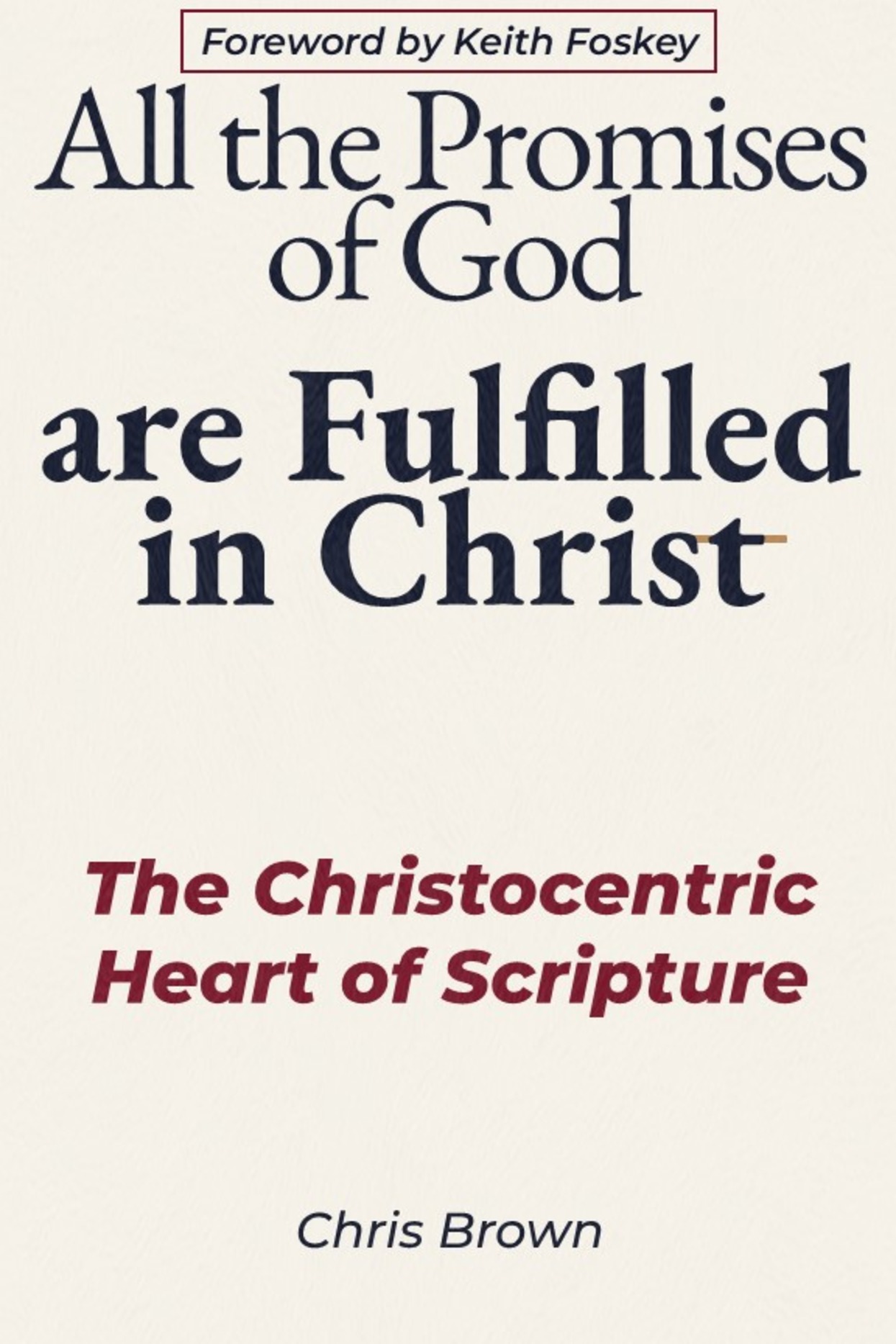
All the Promises of God are Fulfilled in Christ
by Chris Brown
If you found this analysis of Three Theological Frameworks helpful, you'll find the complete theological framework in All the Promises of God are Fulfilled in Christ.
Available now in paperback, Audible, and Kindle.
Notes
- Justin Martyr, Dialogue with Trypho, 11.5; John Chrysostom, Adversus Judaeos, 1.3. For modern articulation: Marcel Simon, Verus Israel: A Study of the Relations Between Christians and Jews in the Roman Empire AD 135-425 (Oxford: Oxford University Press, 1986), 87-124.
- Augustine, City of God, XVIII.46: "After the rejection of the Jews, who slew Christ, the Gentiles have been chosen." See also Augustine, Against the Jews, 7.9.
- This position is articulated in the Epistle of Barnabas, 13-14, and developed through patristic literature. See Rosemary Radford Ruether, Faith and Fratricide: The Theological Roots of Anti-Semitism (New York: Seabury Press, 1974), 117-182.
- Augustine, City of God, XVIII.46-47; Tractates on the Gospel of John, 7.24. Augustine viewed the Jews as witnesses to Christian truth but no longer God's special people. See Paula Fredriksen, Augustine and the Jews: A Christian Defense of Jews and Judaism (New Haven: Yale University Press, 2010).
- John Calvin, Institutes of the Christian Religion, II.11.4-10; Commentary on Romans 11:1-25. Calvin taught that God's covenant with Israel was transferred to the church, though he maintained that individual Jews could still be saved. See R. Kendall Soulen, The God of Israel and Christian Theology (Minneapolis: Fortress Press, 1996), 57-69.
- Martin Luther, On the Jews and Their Lies (1543); Against the Sabbatarians (1538). Luther initially hoped for Jewish conversion but later developed harsh supersessionist views. See Heiko Oberman, The Roots of Anti-Semitism in the Age of Renaissance and Reformation (Philadelphia: Fortress Press, 1984), 38-64.
- For analysis of later developments, see Michael Vlach, Has the Church Replaced Israel? A Theological Evaluation (Nashville: B&H Academic, 2010), 41-67; and Jeffrey S. Siker, Disinheriting the Jews: Abraham in Early Christian Controversy (Louisville: Westminster John Knox, 1991).
- For historical analysis of supersessionism's role in anti-Semitism, see Ruether, Faith and Fratricide, 228-259; and Jules Isaac, The Teaching of Contempt: Christian Roots of Anti-Semitism (New York: Holt, Rinehart and Winston, 1964).
- Westminster Confession of Faith, VII.5-6; Louis Berkhof, Systematic Theology (Grand Rapids: Eerdmans, 1938), 271-301; Herman Ridderbos, Paul: An Outline of His Theology (Grand Rapids: Eerdmans, 1975), 327-361.
- John Murray, The Covenant of Grace (Phillipsburg: Presbyterian and Reformed, 1988), 15-32; Meredith Kline, Kingdom Prologue (Eugene: Wipf & Stock, 2006), 321-354.
- Charles Hodge, Systematic Theology, vol. 2 (New York: Scribner, 1872), 374-377; Geerhardus Vos, Biblical Theology (Grand Rapids: Eerdmans, 1948), 234-267.
- O. Palmer Robertson, The Christ of the Covenants (Phillipsburg: Presbyterian and Reformed, 1980), 45-67; Willem VanGemeren, The Progress of Redemption (Grand Rapids: Zondervan, 1988), 89-124.
- John Calvin, Commentary on Romans 11:17-24; Abraham Kuyper, The Work of the Holy Spirit (Grand Rapids: Eerdmans, 1900), 345-367.
- Westminster Confession of Faith, VIII.6; Francis Turretin, Institutes of Elenctic Theology, vol. 2 (Phillipsburg: Presbyterian and Reformed, 1994), 192-234.
- This framework builds on Hebrews 8:5, 10:1; Colossians 2:16-17. See Richard Davidson, Typology in Scripture (Berrien Springs: Andrews University Press, 1981), 167-234; David L. Baker, Two Testaments, One Bible (Leicester: Apollos, 1991), 239-267.
- For shadow-substance typology, see Hebrews 8:5, 10:1; Colossians 2:16-17. Theological development in Geerhardus Vos, Biblical Theology (Grand Rapids: Eerdmans, 1948), 140-168.
- The concept of typological fulfillment is developed in Leonhard Goppelt, Typos: The Typological Interpretation of the Old Testament in the New (Grand Rapids: Eerdmans, 1982), 127-189.
- Matthew 2:15; Hosea 11:1. See Rikki Watts, Isaiah's New Exodus and Mark (Tübingen: Mohr Siebeck, 1997), 78-124, on Jesus as the true Israel.
- Romans 6:1-11; Galatians 2:20; Ephesians 2:6. Union with Christ theology developed in John Murray, Redemption Accomplished and Applied (Grand Rapids: Eerdmans, 1955), 161-173.
- Genesis 12:3; 22:18; Galatians 3:8, 16, 29. See Thomas Schreiner, The Law and Its Fulfillment (Grand Rapids: Baker Books, 1993), 87-134.
- Matthew 21:33-46; Luke 13:6-9; 14:16-24. See N.T. Wright, Jesus and the Victory of God (Minneapolis: Fortress Press, 1996), 176-197, on Jesus' warnings to Israel.