What Does the Bible Say About Government? (and Why Most Christians Miss It)
Editor's Note: This article is an adapted excerpt from the book The Stone and the State by Chris Brown.
June 11, 2026 - Chris Brown
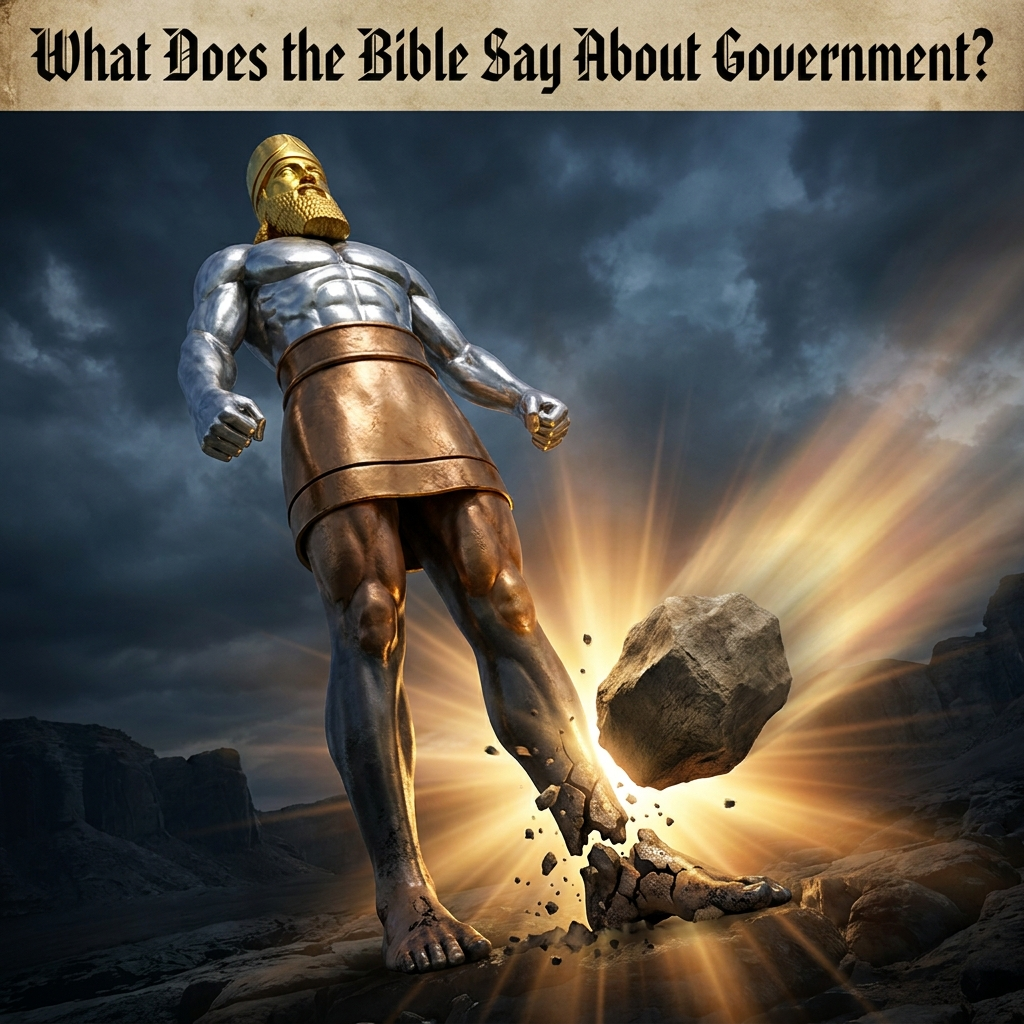



Christians have debated their relationship to civil government for as long as there have been Christians. Some have crowned kings in the name of God. Others have refused to vote, hold office, or serve in any civil capacity. Most fall somewhere in the wide and confused middle, unsure whether their political convictions come from the Bible, their upbringing, or the last thing they read online. The confusion is not incidental. It reflects a genuine gap in Christian thinking — a question that most traditions have answered inadequately, if they have answered it at all. What does the Bible say about government? Not about specific policies. Not about which party a Christian should support. About the civil state itself: what authority it holds, where that authority comes from, how far it extends, and where it ends. Scripture does not leave these questions unanswered.
The Debate Is Being Fought at the Wrong Level
When Christians argue about government, they typically argue about outcomes. They debate tax policy, immigration, criminal justice, and the role of the church in public life. These are not unimportant conversations. But they are downstream of a more foundational question that most participants have never thought to ask: on what covenantal basis does the civil state derive its authority? That question sounds academic. It is not. The answer shapes every other conclusion. A Christian who believes the state's authority flows from the Mosaic Law will draw different conclusions than one who understands it as flowing from a universal covenant that predates Israel by centuries. A Christian who believes the state exists to advance the kingdom of God will engage politically in a fundamentally different posture than one who understands the state as a preservation mechanism for fallen humanity, bounded by a mandate it did not give itself and cannot revise. The Bible addresses this question with precision. Getting the foundation right is not optional.
Why the Old Testament Law Cannot Be the Framework
The most persistent error in Christian political thinking is the assumption that the Old Testament's civil law provides the template for modern governance. The appeal is understandable. The Mosaic Law addresses theft, murder, property disputes, and the administration of justice. It appears to be exactly the political framework the Bible offers. But this reading misunderstands what the Mosaic covenant actually was and what Christ actually did with it.
The Mosaic covenant was not a universal moral code deposited for all nations in all times. It was a specific covenantal administration given to a specific people, for a specific land, under specific terms. It was bounded in every direction: by ethnicity, by geography, and by time. And it was brought to its appointed completion in Jesus Christ. The New Testament is unambiguous on this point. Christ supersedes Moses. The Old Covenant was not a permanent foundation awaiting fuller application. It was a specific structure of redemptive history that Christ fulfilled and abrogated in his person and work. To press the Mosaic civil code into service for modern governments is to strip it from the covenant relationship that gave it coherence. It is not a stronger reading of the Bible. It is a misreading of what kind of document the Old Covenant was.
This raises an urgent question. If the Mosaic Law is not the framework for civil government, is there a biblical framework at all? There is. It predates Moses by centuries, and the New Testament's own political reasoning assumes it on every page.
The Noahic Covenant: God's Universal Charter for Civil Life
Before there was Israel, before Sinai, before the law, God struck a covenant with all of humanity. After the flood, in the opening verses of Genesis 9, God issued what amounts to a legal charter for human civilization: "Whoever sheds the blood of man, by man shall his blood be shed, for God made man in his own image" (Genesis 9:6). This is not a proverb about the natural consequences of violence. It is a formal authorization. God delegated to human society the right and responsibility to protect the image-bearer through the administration of civil justice. The ground for that delegation is not ethnic, not religious, and not provisional in the way the Mosaic covenant was provisional. It is universal, grounded in the creation dignity of every human being, and it remains in force while the earth remains (Genesis 8:22).
This is the Noahic covenant, and it is the covenantal framework the New Testament assumes every time it addresses civil government. Paul writes to believers living under the Roman emperor Nero — a man who had no relationship with the God of Israel and no connection to the Mosaic covenant. Paul does not qualify his instruction with any observation that Nero's government lacks legitimate standing. He states plainly that governing authority is "instituted by God," that the ruler is "God's servant for your good," and that the state "does not bear the sword in vain" (Romans 13:1, 4). The question that passage raises is precisely the question the Noahic covenant answers: on what basis can a pagan Caesar function as a legitimate minister of God's justice? Not on the basis of Sinai. On the basis of Genesis 9, the universal charter God issued for all humanity without ethnic or religious qualification.
Peter confirms the same framework from a different angle. Writing to believers scattered across pagan provinces, he commands submission to the emperor and to governors sent "to punish those who do evil and to praise those who do good" (1 Peter 2:13-14). The mandate Peter assigns to the civil state is precise and restricted. Pagan governors are sent for one purpose: the preservation of civic order. Peter deliberately withholds from the state the vocabulary of holiness and kingdom that he reserves for the church alone: "you are a chosen race, a royal priesthood, a holy nation" (1 Peter 2:9). What the church is, the state is not and cannot be. The state's mandate is civic preservation. That is exactly the Noahic mandate.
Jesus himself confirmed the same framework when the Pharisees tried to trap him on the question of Roman taxation. His answer established something the Mosaic arrangement would never have permitted: "Render to Caesar the things that are Caesar's, and to God the things that are God's" (Matthew 22:21). Under the Mosaic Covenant, in the nation of Israel, God owned everything — the taxes, the land, and the governing authority. Caesar had no separate domain. By acknowledging Caesar's legitimate claim over a distinct civil sphere, Jesus created exactly the space the Noahic covenant authorizes: a civil order that is real, legitimate, bounded, and distinct from the covenant community of God's people.
What This Means for the Christian Today
Understanding what the Bible says about government does not produce political resignation. It produces political clarity. The civil state has genuine authority. It is "instituted by God" in the most direct sense — not merely permitted or tolerated. The Christian who serves in civil life, who votes, holds office, administers law, or works in public institutions, is doing work that the Noahic covenant has authorized and that God himself takes seriously. Competent and conscientious work in civil life is not a compromise with the world. It is the faithful administration of a God-given mandate.
But the state's authority is bounded. It is authorized for the preservation of civic order, not for the regulation of the conscience before God, and not for the advance of the gospel. Salvation takes place beneath the providential canopy that civil order preserves. The state is not an instrument of the gospel, and the gospel is not an instrument of the state. These are distinct orders with distinct mandates. The Christian who keeps that distinction clear will navigate public life with a kind of clarity that neither uncritical loyalty to the state nor reflexive withdrawal from it can produce.
The Noahic covenant is also explicitly temporary. God struck it "while the earth remains" (Genesis 8:22). It has an expiration date, and the New Testament names it: the return of Jesus Christ, when every human governing authority will be dissolved and the unmediated reign of the risen King will replace them all (Revelation 11:15). The state belongs to this age. It is not the kingdom. It is the outpost the kingdom passes through on its way to its final consummation. The believer who understands this serves faithfully within civil structures, refuses their idolatrous demands with clarity, and bears witness to a kingdom whose advance does not depend on the state and cannot be stopped by the state's opposition. That is what the Bible says about government — not a policy manual, but a covenantal framework grounded in Genesis 9, confirmed throughout the New Testament, and sufficient for every question the Christian will face in the political order of the present age.
_______________
Deepen your study.
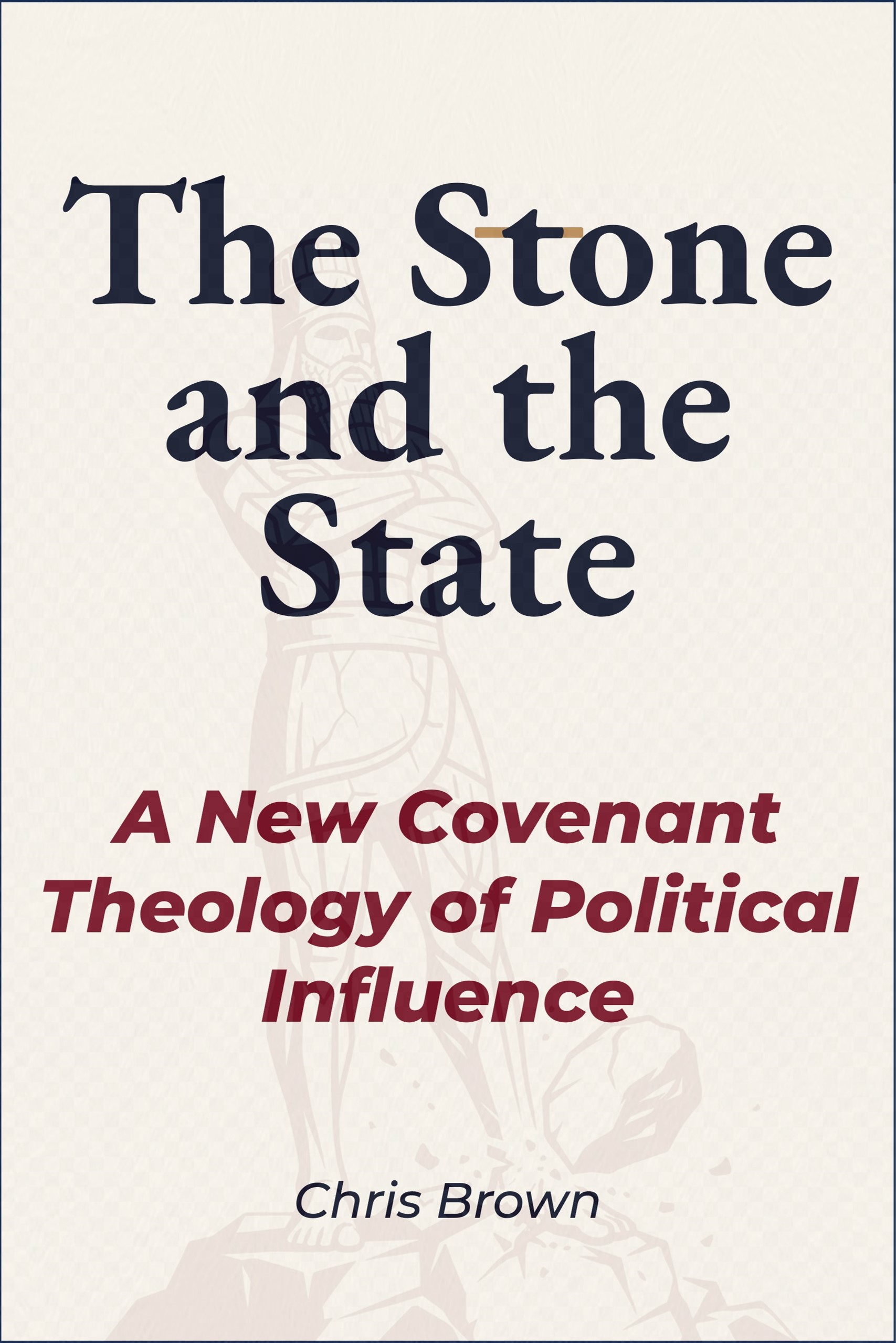
The Stone and the State
by Chris Brown
If you found this article helpful you'll find the complete theological framework in The Stone and the State.
Available now on Amazon.