The Suzerain Vassal Treaty: The Ancient Legal Framework Behind God's Covenant with Israel
July 22, 2026 - Chris Brown
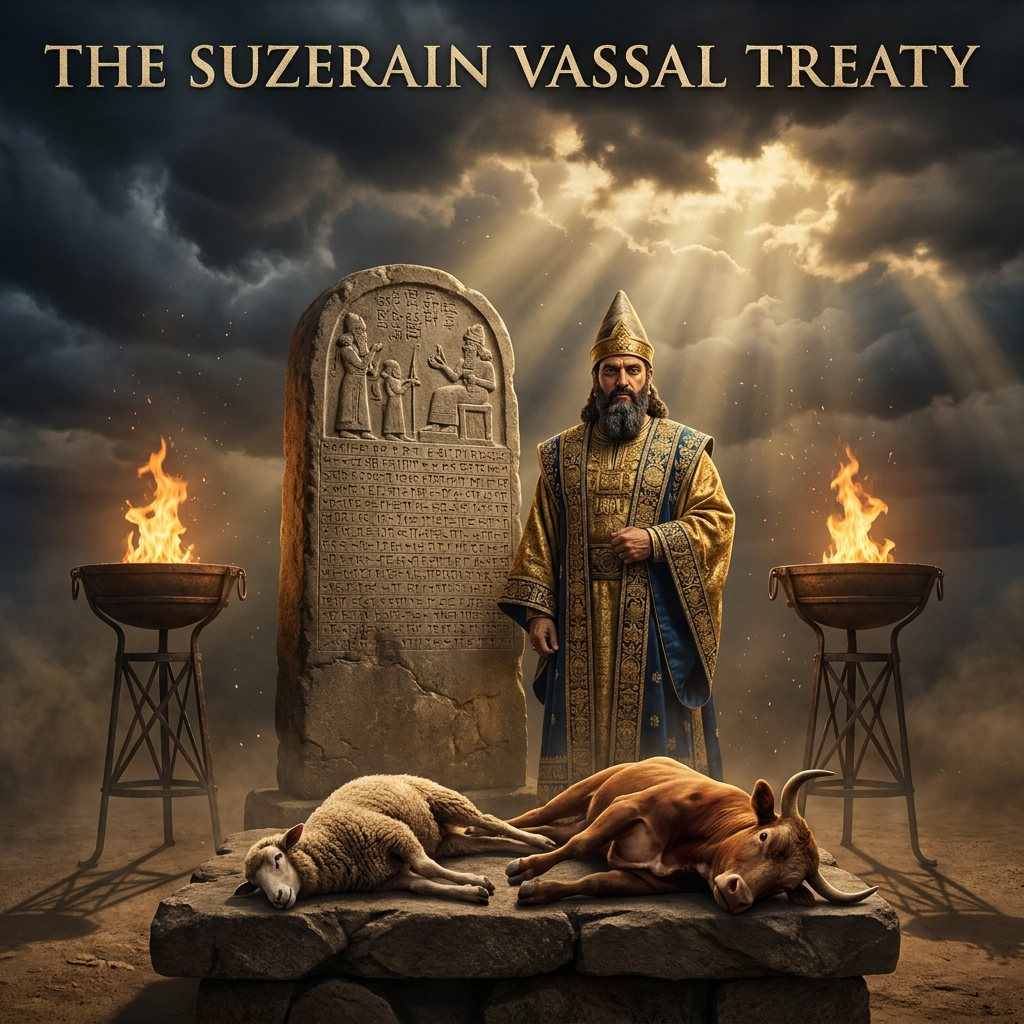



When God descended on Sinai and spoke the Ten Commandments to Israel, He was not simply issuing a moral code into a vacuum. He was doing something that every person standing at the foot of that mountain would have immediately recognized: He was establishing a treaty. Not a treaty between equals, but the specific, legally structured form that defined the relationship between a conquering king and a subordinate people. Scholars call this the suzerain vassal treaty, and understanding it may be the single most clarifying key you will ever hold in your hand when you open the Old Testament.
The suzerain vassal treaty was the dominant political and legal contract of the Late Bronze Age, most fully documented in the surviving records of the Hittite Empire (roughly 1400 to 1200 BC). When a great king, the suzerain, extended sovereignty over a smaller nation or people, the vassal, the relationship was formalized in a document with a precise, six-part structure. Archaeologists have recovered dozens of these treaties, and biblical scholars noticed decades ago that the books of Exodus and Deuteronomy follow the same structure with a precision that cannot be accidental. God did not invent a new legal form. He took the one the ancient world already understood perfectly, and He filled it with the weight of His own sovereign grace.
The Six-Part Structure and Where You Find It
The standard Hittite suzerain vassal treaty contained six elements, always in the same order: first, a preamble identifying the great king; second, a historical prologue recounting what the suzerain had already done for the vassal; third, the stipulations, both general and specific, that the vassal was required to keep; fourth, provisions for depositing the document and reading it publicly at regular intervals; fifth, a list of divine witnesses to the treaty; and sixth, a catalogue of blessings for faithfulness and curses for breach of contract.
Deuteronomy follows this template with remarkable exactness. The preamble appears in Deuteronomy 1:1-5, identifying Yahweh as sovereign and Moses as His spokesman. The historical prologue fills chapters 1 through 4, recounting God's faithfulness from Horeb through the wilderness wanderings. The general and specific stipulations run from chapter 5 through chapter 26, beginning with the Ten Commandments and extending through the detailed civic and religious law. The deposition and public reading provisions appear in 27:1-10 and 31:9-13, where the law is to be written on stones, kept by the priests, and read aloud every seven years. Heaven and earth are invoked as witnesses in 30:19 and 32:1. And the blessings and curses of chapter 28, one of the most sobering passages in all of Scripture, correspond precisely to the treaty sanction lists: specific blessings for obedience and specific curses, including siege, famine, disease, and exile, for rebellion.
This is not loose thematic resemblance. This is structural identity. The entire book of Deuteronomy is a fourteenth-century BC treaty document, and God wrote it that way on purpose.
Grace Before Law: The Historical Prologue Changes Everything
One of the most misunderstood features of Old Testament law, and one the suzerain vassal treaty framework resolves immediately, is the relationship between grace and obligation. Popular imagination treats the Old Testament as the covenant of law and the New Testament as the covenant of grace, as though Sinai was primarily about earning God's favor through moral performance. The suzerain vassal treaty shows why this reading is deeply mistaken.
In Hittite treaty practice, the historical prologue was not optional decoration. The great king was required to list his benevolent acts toward the vassal before he could demand anything. He had to prove that he had already acted as savior before he could speak as legislator. The logic was irreversible: obligation followed grace, never the reverse.
The Ten Commandments do not begin with a command. They begin with a historical prologue: 'I am the Lord your God, who brought you out of Egypt, out of the land of slavery' (Exodus 20:2). The deliverance came first. The moral demand followed as the proper response of a people who had already been redeemed (physically). To read the Mosaic law as a mechanism for earning God's favor is to read it backwards. The suzerain vassal treaty framework makes this plain: God acted as Savior before He spoke as Lawgiver, and the stipulations that followed were never intended to establish the relationship but to govern those already in it.
"Love" and "Hate" as Legal Terms
This same framework clarifies one of the passages that modern readers find most troubling in all of Scripture. When Malachi 1:3 records God saying 'Jacob I have loved, but Esau I have hated,' the instinctive modern reading is one of emotional preference or divine cruelty. The suzerain vassal treaty corrects that instinct entirely.
In Ancient Near Eastern treaty language, 'love' and 'hate' were not primarily affective or emotional terms. They were strict legal designations. To love the suzerain meant to maintain absolute political loyalty, exclusive allegiance, and complete obedience to the treaty terms. To hate meant to commit treason: to violate the covenant, to form unauthorized alliances with rival powers, to break the bond of exclusive relationship. When Deuteronomy commands Israel to 'love the Lord your God with all your heart, and with all your soul, and with all your might' (Deuteronomy 6:5), it is deploying precise treaty language requiring exclusive covenantal loyalty. And when Malachi records that God loved Jacob and hated Esau, it is expressing covenant selection and legal alignment, not divine emotional favoritism. Jacob's line was chosen as the vassal people of God's redemptive purposes. Esau's line was not. The language is legal before it is emotional.
Genesis 15 and the Most Astonishing Inversion in Scripture
The ratification of ancient treaties involved what scholars call the self-maledictory oath: a curse the vassal invoked upon himself by his own action. Typically, animals were cut in half and laid in two rows. The vassal would then walk between the pieces, enacting the declaration: if I fail to keep these terms, may I be torn apart as these animals have been torn apart. The physical action was a living curse, accepted in advance as the penalty for covenant breach.
This is the background to Genesis 15, where God instructs Abraham to cut animals in half and arrange the pieces. Abraham waits through the day. When the sun has set and darkness falls, a smoking firepot and a blazing torch, representing the divine presence, pass between the pieces. Abraham does not walk through them. Only God moves between the divided animals. The suzerain took the self-maledictory oath upon Himself.
The implications are staggering. God bound Himself, in the form of a covenant curse, to bear the penalty of the covenant's breach. If this covenant were to break, the Great King would be the one torn apart. What God promised to Abraham in Genesis 15 was fulfilled at Calvary, where the Son of God bore exactly the covenantal curse that Israel's perpetual unfaithfulness had accumulated. The cross was not an accident. It was the covenant enforced, and the suzerain paid it Himself.
The Prophets as Covenant Attorneys
Because the suzerain vassal treaty was a binding legal contract, every act of Israel's idolatry and foreign alliance was a breach of covenant. The nation was, in legal terms, committing treason against the Great King. And a covenant breach required a legal response.
This is the framework that makes sense of the Hebrew prophets. Isaiah, Jeremiah, Hosea, Amos, and Micah were not primarily predictors of the distant future. They were covenant prosecuting attorneys. In Hebrew, the formal legal action they conducted is called a rib, a covenant lawsuit. When a prophet opens with the invocation of heaven and earth as witnesses, as Isaiah does in Isaiah 1:2, he is calling the treaty witnesses to testify. When he recites Israel's offenses, he is reading the specific charges against the stipulations of Deuteronomy. When he announces judgment, he is formally declaring which curses from Deuteronomy 28 are about to be enforced. The prophetic literature is covenant litigation. The suzerain vassal treaty is the legal code under which it operates.
Why the Old Covenant Had to Die
This legal framework also illuminates why the Old Covenant could not simply be revised or extended into the New. It had to end. It had to die.
The Mosaic Covenant was not a mistake, nor was it set aside because Israel proved unexpectedly rebellious. It was designed by God with a built-in obsolescence, because it was always a shadow pointing forward to the substance. The stipulations, the priesthood, the temple sacrifices, the land, circumcision as the physical sign of covenant membership, all of these were types pointing beyond themselves to the realities that Christ would bring. Israel, as an unregenerate national entity apart from the believing remnant within it, was never the final people of God. It was a typological nation, shaped by God to function as a visible signpost directing the world toward the Messiah who would come from within it and through whom God's promises to Abraham would reach every nation.
Circumcision, in particular, was the ultimate identity marker under the Mosaic administration, the physical sign that distinguished the covenant member from the outsider. But with the arrival of the New Covenant, Paul argued with full force that physical circumcision no longer carried the weight it once had. True circumcision was now inward and spiritual (Romans 2:28-29). Those who insisted on physical circumcision as the means of covenant standing were, in the legal terms of the suzerain vassal framework, refusing to accept that the treaty had been superseded by a new and better covenant in Christ's blood. They were clinging to the shadow after the substance had arrived.
God's response, in the most historically visible act of covenant enforcement in the first century, was the destruction of Jerusalem and the Temple in AD 70. The Roman legions under Titus executed, with terrible precision, the exact curses that Deuteronomy 28 had specified for covenant breach: a foreign nation besieging the cities, severe famine during the siege, and the scattering of the people among the nations. Jesus Himself had foretold it: 'For this is the time of punishment in fulfillment of all that has been written' (Luke 21:22). The destruction of the temple and the permanent ending of the Levitical system was the final act of the old covenant lawsuit. The physical framework of circumcision, priesthood, and sacrifice was dismantled from the outside, historically and permanently. There was no longer a temple for circumcised citizens to approach. The old treaty was not merely ratified into obsolescence. It was judicially closed.
What This Means for You
Understanding the suzerain vassal treaty does not merely satisfy historical curiosity. It transforms the way you read your Bible. The law that flows from Sinai is not arbitrary moral legislation. It is the stipulation section of a covenant document, preceded by a historical prologue of grace. The prophets are not wild-eyed visionaries. They are covenant attorneys filing lawsuits against a treaty-breaking nation. The curses of Deuteronomy 28 are not divine vindictiveness. They are the self-maledictory penalties that Israel accepted at Sinai, now being enforced. And the New Covenant in Christ's blood is not a correction of a failed plan. It is the fulfillment of the promise God swore to Abraham in Genesis 15, when the suzerain passed alone between the pieces and bound Himself to bear every cost of keeping His word.
'For all the promises of God find their Yes in him. That is why it is through him that we utter our Amen to God for his glory' (2 Corinthians 1:20).
Every promise God made to Israel, from Sinai to the prophets to the land and the throne, was always a promise made through Israel to Christ and to all who are united to Him. The shadow has passed. The substance has come. And the Great King paid everything He promised to pay.
_______________Deepen your study.
All the Promises of God are
Fulfilled in Christ
by Chris Brown
If you found this article helpful you'll find the complete theological framework in All the Promises are Fulfilled in Christ.
Available now on Amazon.